
What's New
Projects in Late 2025
Natives in the Garden:
As we deal with the new normal and impending changes in our climate, there is a lot of interest in the flowers which are native to our area. It is expected that the native plants will survive despite the changes that may take place in the area. Obviously, each area will have its own native plants. You can check at your local Extension office for a list of natives for your area.
When thinking of natives, people tend to think of wildflower meadows. That is not the only way you can welcome natives to your garden. You can incorporate natives into your flower beds, taking into consideration their requirements. I will highlight a few that adorn my garden, showing up at different times and in different parts of my garden.
Trillium or Wake Robin appear very early in my woodland garden – most often in March. This native is known for its mottled, three-lobed leaves. From the middle of each set of leaves emerges a flower which has three petals. Mine are an interesting chocolate color. They show up, flower, and then the plant just disappears. That is why it is called an ephemeral.
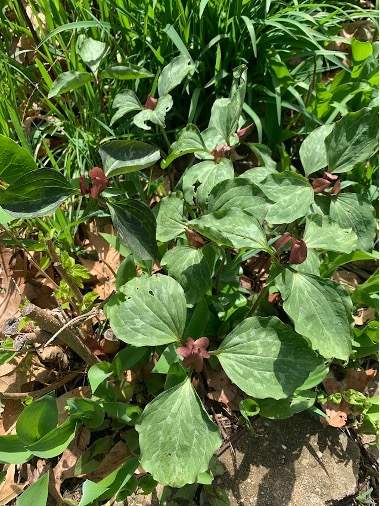
Trillium (Trillium grandiflorum)
Solomon Seal is also a woodland native but it lasts the whole season. I have a variegated kind, which grows from a rhizome. Early in spring, the arching stems show up with alternate, variegated leaves, green with creamy margins. Soon thereafter, lovely bell-shaped white flowers appear on the underside of the stems. They are one of the most beautiful plants in the early season. After the flowers bloom, the leaves continue with their lovely green presence. This plant does not disappear; in fall it provides creamy yellow fall color to end the season.
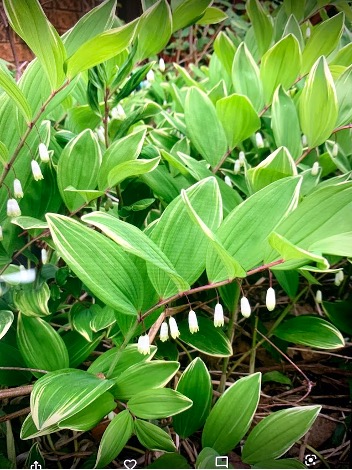
Variegated Solomon Seal (Polygonatum odoratum ‘Variegatum’)
Echinacea and Black-eyed Susan are the quintessential natives that adorn the late summer garden. As most gardeners have them, I have not featured the flowers here.
In late summer to early fall, they are followed by golden rod. – which tends to overwhelm all ditches and wild spaces with its exuberance. Few people know how to welcome them in their limited garden spaces. I allow it to flourish in one part of my border, easily accessible, so I can enjoy watching the bees feasting on their pollen. Make sure to dig out the creeping roots around the clump because they will spread around
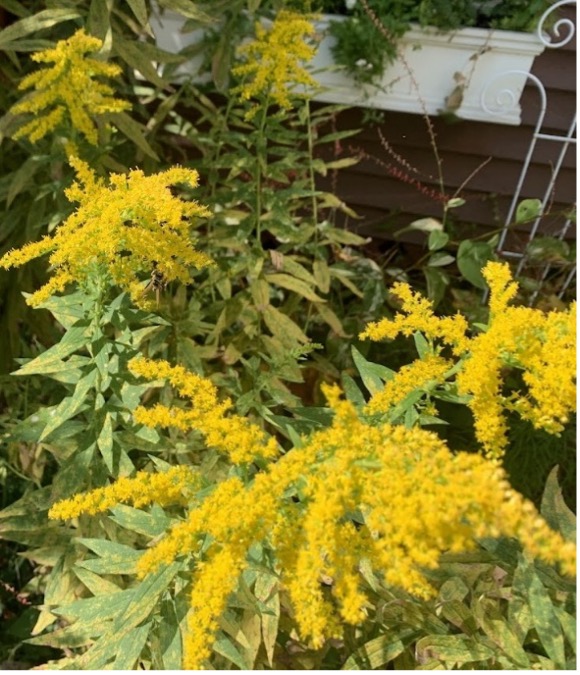
Goldenrod (Solidago gigantea)
The season ends with the asters. They are varied and plentiful. The way I manage them is to limit their clumps, still allowing them to flourish for the pollinators. To keep them in a manageable size, I Chelsea chop the tall ones, usually in late May. That way, I can give them a star role in my borders in fall, without being overwhelmed by them.
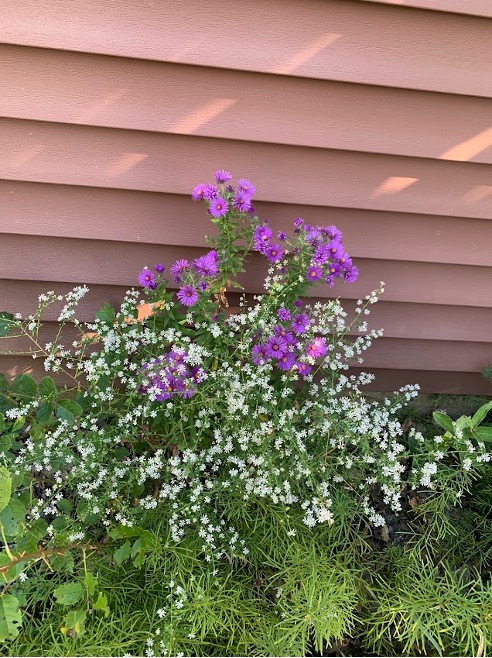
Smooth Blue Aster (Symphyotrichum leave) and White Wood Aster (Aster divaricatus)
This gives you a taste for how I use native plants in my garden. There are many, many more that flourish year after year, with little input from me. You can find out more about how I use them in my book The Garden Primer available on Amazon. Also, you can look out for my next book, right now a work in progress, which is more about my own garden, called The Stop and Look Garden.
Projects in Early 2025
Manuscript The School at 8th Cross:
I’m putting together a book on how CEF and CMVK were started in 1994, and about how we have been running the school for students with special needs in India. Expected date of publication is sometime in 2025.
Teaching gardening one pot at a time:
I’m piloting a program to help senior citizens (with only balconies) and apartment dwellers learn how to grow food. There are two cohorts – one in Kolkata, India, and one in Washington (my town) IL, USA. The Kolkata project will be in collaboration with SNU (Sister Nivedita University) Kolkata.